
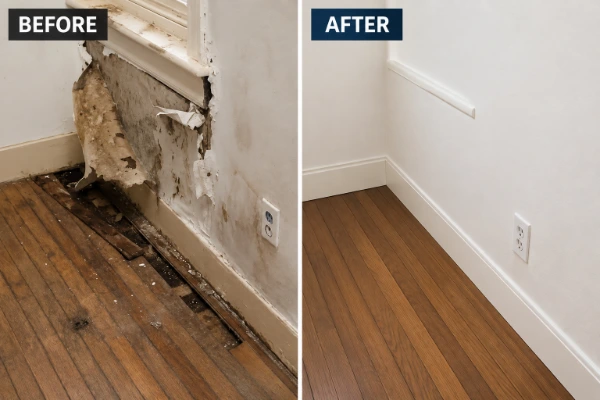
Emergency Water Extraction
in Boca Raton
Truck-mounted extraction within 60 minutes — every hour of standing water multiplies your restoration cost and mold risk. We extract, dry, and verify with moisture meters so nothing is left to guesswork.
Why the First 60 Minutes Decide Everything
Standing water does not wait. Within the first hour, water migrates from flooring into carpet padding, subfloor plywood, and the bottom plates of drywall. By hour four, laminate flooring starts delaminating and particleboard cabinets begin to swell beyond repair. By hour twenty-four, mold colonies establish themselves in the warm, humid conditions that define every Boca Raton home.
This timeline compresses further during summer months when indoor humidity already hovers near 65 percent before any water event. A pipe burst behind a bathroom wall at midnight can saturate an entire hallway before anyone notices. An appliance leak from a washing machine supply line can release 500 gallons per hour if the braided hose fails completely.
Professional water extraction changes the equation. Truck-mounted extractors pull water at 25 gallons per minute, emptying a flooded 200-square-foot room in under 30 minutes. That speed prevents the secondary damage — mold, structural compromise, electrical hazards — that turns a manageable repair into a full-scale restoration project.
Boca Raton Climate Reality
With average relative humidity above 70% year-round and summer temperatures consistently above 90°F, water trapped inside wall cavities or under flooring creates ideal mold conditions faster than anywhere in the continental United States. Extraction speed is not a convenience — it is the single largest factor in your total restoration cost.
Understanding Water Categories and Why They Matter
Not all water damage is the same, and the category of water determines the extraction approach, safety protocols, and whether affected materials can be saved or must be removed.
Category 1 — Clean Water
Water from a supply line break, faucet failure, or overflowing AC drain pan starts as clean water. Carpet, padding, and drywall contacted by Category 1 water can often be dried in place if extraction begins within the first few hours. The key word is “starts” — clean water sitting on a floor for more than 48 hours downgrades to Category 2 as bacteria multiply in the stagnant moisture.
Category 2 — Gray Water
Dishwasher discharge, washing machine overflow, and toilet overflow without solid waste fall into Category 2. Gray water contains microorganisms and chemical contaminants that require antimicrobial treatment during extraction. Carpet padding exposed to gray water is typically removed rather than dried, while hard surfaces can be sanitized and preserved.
Category 3 — Black Water
Sewage backups, storm surge flooding, and any water that has contacted soil or organic waste classify as Category 3. Black water extraction requires full PPE, negative air containment, and removal of all porous materials the water contacted. In Boca Raton, rising groundwater during king tide events in October and November can push sewage through floor drains in older homes along the Intracoastal, turning a minor backup into a Category 3 event.
Homeowners Ask
How do I know if I need professional extraction or if I can handle it myself?
If the affected area is smaller than a bathroom mat and the water is from a clean source you just witnessed, towels and a fan may suffice. Anything beyond that — water covering more than 20 square feet, water from an unknown source, water that reached carpet padding or sat for more than an hour — requires professional extraction equipment to prevent hidden moisture from causing mold and structural damage weeks later.
Our Water Extraction Process: Start to Verified Dry
Phase 1 — Emergency Assessment (0–20 Minutes On-Site)
Our technician locates and stops the water source if still active, documents the affected area with thermal imaging and moisture meters, classifies the water category, and determines extraction scope. We map moisture readings room by room to build a drying plan before equipment deployment.
Phase 2 — Standing Water Removal (20–90 Minutes)
Truck-mounted extractors rated at 25+ gallons per minute remove visible standing water. For water depths above two inches, submersible pumps handle initial volume reduction before extractors take over. Hard-surface wands work tile, LVP, and hardwood. Weighted carpet extractors press into carpet and padding to pull trapped water that surface extraction misses.
Phase 3 — Subsurface Extraction (1–3 Hours)
After surface water is gone, technicians focus on water trapped below the visible layer. Floor injection systems force air beneath hardwood to lift moisture without removing planks. Carpet and padding are lifted in saturated zones for direct pad extraction or pad removal when contamination warrants it. Baseboards are detached to access wall cavity moisture.
Phase 4 — Structural Drying Setup (2–4 Hours)
Commercial dehumidifiers rated at 75+ pints per day and high-velocity air movers are positioned based on the moisture map. In Boca Raton’s humid climate, we typically deploy one dehumidifier per 500 square feet and one air mover per 50 linear feet of wet wall. Drying equipment runs continuously for 3–5 days with daily monitoring visits.
Phase 5 — Moisture Monitoring (Days 1–5)
Daily readings with pin-type and pinless moisture meters track drying progress at every documented point from the initial assessment. We log readings against IICRC S500 dry standards specific to each material — hardwood, concrete slab, drywall, and framing lumber each have different target moisture content levels. Equipment placement adjusts based on which areas are drying slower.
Phase 6 — Verified Completion
Equipment is removed only when every mapped point reads at or below dry standard. We provide a final moisture report documenting initial readings, daily progress, and confirmed dry readings — this documentation supports your insurance claim and proves the structure was returned to pre-loss moisture levels.
Extraction Equipment: What We Bring and Why It Matters
Consumer-grade equipment cannot match the extraction rates needed to prevent secondary damage in South Florida’s climate. Here is what arrives on every emergency call and how each piece fits the extraction strategy.
1. Truck-Mounted Extractor
Powered by a dedicated engine in the service vehicle, truck-mounted units generate sustained vacuum at 25+ gallons per minute — roughly 15 times the capacity of the best consumer wet-dry vacuum. The unit stays outside, connected by hose runs up to 200 feet, so extracted water goes directly to the truck’s waste tank rather than being dumped on your property.
2. Submersible Pump
When standing water exceeds two inches — common in storm surge events and major supply-line failures — submersible pumps handle bulk removal before extractors begin. These pumps sit directly in the water and discharge through rigid hose lines to exterior drainage points, clearing a flooded living room in under 20 minutes.
3. Weighted Carpet Extractor
Standard extraction wands skim water from carpet surfaces but leave saturated padding beneath. Weighted extractors press 50+ pounds of downforce into the carpet face, compressing padding and forcing trapped water upward into the vacuum path. This single tool often determines whether carpet and padding can be saved or must be replaced.
4. Hard-Surface Wand
Tile, LVP, and sealed concrete require a different extraction approach than carpet. Hard-surface wands use a squeegee lip and high-velocity airflow to capture water from smooth surfaces without scratching finishes. On hardwood, specialized wands work in the direction of the wood grain to minimize surface disruption during extraction.
5. Moisture Detection Array
Pin-type meters measure moisture content inside wood and drywall by inserting probes directly into the material. Pinless meters use radio frequency to scan behind surfaces without penetration. Thermal imaging cameras reveal temperature differentials that indicate hidden moisture in wall cavities, ceiling spaces, and beneath cabinetry. Together, these tools map every wet zone in the structure so nothing dries by accident.
Where Water Hides in Boca Raton Homes
Every home style in Boca Raton presents unique extraction challenges based on its construction era, foundation type, and common materials. Knowing where water migrates in your specific home type helps you understand why professional extraction goes beyond mopping up visible puddles.
Boca Bayou & Sabal Shores
1970s–80s construction with cast-iron drain stacks and concrete block walls. Water from slab leaks travels along the monolithic slab edge and appears far from the actual leak source. Extraction requires moisture mapping the entire slab perimeter.
Boca Falls & Saturnia
Late 1990s two-story homes with second-floor laundry rooms. Supply-line failures upstairs send water through floor joists and ceiling cavities before becoming visible on the first floor. Extraction must address both levels and the interstitial space between them.
Mizner Tower & Townsend Place
High-rise condo units where AC condensate failures are the leading cause of water damage. Water follows the path of least resistance through penetrations in the concrete slab, often affecting the unit below.
Boca Pointe & Boca del Mar
1980s communities with aging copper and original polybutylene plumbing. Pinhole leaks in copper supply lines create slow saturation behind walls that may run for days before detection. Extraction must cover wall cavities spanning multiple rooms.
Royal Palm & Broken Sound
Estate homes with extensive landscaping and irrigation systems. Ground-level flooding from broken irrigation mains pushes water under exterior doors. Seasonal vacancy means these events can run for hours before anyone notices.
Sabal Ridge & One Thousand Ocean
Oceanfront high-rises exposed to salt-air corrosion on plumbing fittings and AC components. Corroded compression fittings on AC condensate lines fail without warning. Salt spray accelerates metal degradation, making quarterly plumbing inspections essential.
Homeowners Ask
Will water extraction damage my hardwood floors?
Proper extraction actually saves hardwood floors. The real damage comes from leaving water in contact with hardwood for too long. Professional extractors use grain-direction wands and floor-mat drying systems that pull moisture out of the wood without sanding or refinishing. When extraction starts within the first few hours, hardwood floors can be dried in place about 80 percent of the time. Waiting beyond 24 hours drops that success rate below 40 percent as cupping and crowning set in permanently.
After Extraction: What Happens Next
Extraction removes the standing and trapped water, but the structure remains saturated. In Boca Raton’s climate, a home that was properly extracted still requires 3 to 5 days of controlled structural drying before materials return to normal moisture levels.
Dehumidifiers and air movers work as a system. Air movers push saturated air away from wet surfaces, accelerating evaporation. Dehumidifiers capture that airborne moisture before it recondenses on cooler surfaces elsewhere in the home. Without both working in tandem, you are moving moisture around rather than removing it. Our technicians calculate the exact number of each unit based on cubic footage, material types, and the ambient humidity readings specific to your home on that day.
Daily monitoring visits track drying progress at every point documented during the initial moisture mapping. If a section of wall or subfloor is drying slower than expected, equipment gets repositioned or additional units are added. This active management is what separates professional structural drying from simply leaving fans running and hoping for the best.
The process ends only when every mapped moisture point reads at or below the IICRC S500 dry standard for that specific material. We do not estimate dryness by feel or visual inspection. Verified moisture readings protect you from hidden dampness that causes mold growth and wood rot months after the water event seems resolved.
Warning
Do not turn off drying equipment early. Every year we respond to mold remediation calls from Boca Raton homeowners who shut down dehumidifiers after two days because the home “felt dry.” Surface materials dry first while subfloors and wall cavities retain moisture. Premature equipment removal is the most common cause of secondary mold growth after a water event.
Common Water Extraction Scenarios in Boca Raton
Each water emergency has its own extraction profile. Understanding these scenarios helps you communicate effectively with your restoration team and set realistic expectations for the process.
Supply-line pipe burst
Releases clean water under pressure, potentially flooding multiple rooms within minutes. Shutting off the main water valve immediately stops the source, and Category 1 extraction protocols allow most materials to be saved when we arrive within the hour. Homes in Boca Pointe and Boca del Mar with original polybutylene piping face elevated pipe-burst risk.
Storm and hurricane flooding
Introduces exterior water that is immediately classified as Category 2 or Category 3 depending on what it contacted before entering the home. Extraction must handle higher volumes, and antimicrobial treatment is standard. Homes in low-lying areas near the Hillsboro Canal and along Palmetto Park Road are most frequently affected during named storm events.
AC condensate overflow
The most common water damage source in Boca Raton homes, particularly in communities where units run continuously from April through November. A clogged condensate drain line can deposit 20–30 gallons per day into ceiling spaces, closets, and wall cavities. By the time water appears on a first-floor ceiling, saturation has been building for days.
Water heater failure
Releases 40–80 gallons from the tank plus continuous flow from the supply line until someone shuts the valve. Most Boca Raton water heaters sit in garages, utility closets, or interior laundry rooms where the released water has direct access to living spaces and finished flooring.
Protecting Your Home From Future Water Damage
Install Water Leak Sensors
Place sensors under water heaters, behind washing machines, beneath kitchen sinks, and near AC air handler drain pans. Smart sensors connected to your phone send instant alerts when moisture is detected. A $30 sensor can prevent $30,000 in restoration costs by catching leaks while they are still measured in cups rather than gallons.
Service Your AC Drain Line Quarterly
Pour a cup of distilled white vinegar down the condensate drain line every three months to prevent algae buildup. Have a licensed HVAC technician flush the line with a wet-dry vacuum annually. In Boca Raton, where AC units run 10+ months per year, condensate drain clogs are the leading cause of interior water damage.
Know Your Shut-Off Valves
Locate your main water shut-off valve and test it annually to ensure it turns freely. Identify individual shut-offs for toilets, sinks, and appliances. In an emergency, shutting off water within two minutes versus twenty minutes can reduce total water volume by hundreds of gallons.
Replace Supply Lines Before They Fail
Rubber washing machine hoses and plastic dishwasher supply lines have a 5–8 year lifespan. Replace them with braided stainless steel lines rated for residential pressure. If your home was built before 1995, have a plumber assess whether your system uses polybutylene piping, which has a documented failure rate in South Florida homes.
Homeowners Ask
How much does professional water extraction cost in Boca Raton?
Water extraction costs in Boca Raton typically range from $1,500 to $5,000 depending on the affected area, water category, and extraction complexity. A single-room Category 1 event might cost $1,500–$2,500 while a multi-room Category 3 event requiring antimicrobial treatment and material removal runs $4,000–$8,000. Most homeowners insurance policies cover extraction costs when the damage results from a sudden and accidental event. See our complete cost guide for detailed pricing by scenario.
Water Extraction Questions Boca Raton Homeowners Ask
How long does water extraction take in a typical Boca Raton home?+
Most residential water extractions take 2 to 6 hours depending on the volume of water and the affected area. A single-room pipe burst may take 2 hours of active extraction while a whole-home flood from storm surge or a major supply-line failure can require 8 or more hours of continuous extraction. Structural drying with dehumidifiers and air movers continues for 3 to 5 days after extraction is complete.
Can I do water extraction myself with a shop vac?+
A shop vac removes surface water but cannot extract moisture trapped in carpet padding, subfloor layers, or wall cavities. Professional truck-mounted extractors pull 25 gallons per minute compared to a shop vac’s 1 to 2 gallons, and they reach water that DIY equipment misses entirely. Incomplete extraction leaves hidden moisture that causes mold growth and structural damage weeks later, often costing more to remediate than the original water event.
Does homeowners insurance cover water extraction in Florida?+
Most Florida HO-3 policies cover water extraction when the damage comes from a sudden and accidental event like a pipe burst, water heater failure, or appliance malfunction. Flood damage from rising exterior water requires a separate NFIP or private flood policy. Your insurer will want documentation of the water source, the timeline of events, and a detailed scope of work from the restoration company. Starting the claim process within 24 hours strengthens your claim outcome.
How quickly does mold grow after water damage in Boca Raton?+
In Boca Raton’s subtropical climate with average humidity above 70 percent, mold colonization begins within 24 to 48 hours of water exposure. Visible mold growth typically appears within 3 to 5 days on porous surfaces like drywall, wood, and carpet backing. Rapid extraction within the first 60 minutes significantly reduces mold risk by removing the standing water that feeds spore germination.
What equipment do professionals use for water extraction?+
Professional water extraction uses truck-mounted extractors rated at 25 or more gallons per minute, submersible pumps for standing water above 2 inches, weighted carpet extractors that press into padding to pull trapped water, hard-surface wands designed for tile and hardwood without scratching, and a moisture detection array including pin-type meters, pinless scanners, and thermal imaging cameras.
Should I turn off my AC during water extraction?+
Keep your AC running during and after extraction. Air conditioning lowers indoor humidity, which supports the structural drying process. The one exception is when the water damage involved your HVAC system or ductwork directly — in that case, a technician should inspect the system first to prevent contaminated moisture from spreading through the ductwork to unaffected areas of your home.
Water Emergency in Boca Raton? Every Minute Counts.
Our truck-mounted extraction crews are staged across South Palm Beach County for 60-minute response anywhere in Boca Raton. The longer water sits, the more it costs to fix. Call now and we will start extraction within the hour.
☎ (561) 979-0504 — 24/7 Emergency ExtractionRelated Resources
Water Damage Restoration Boca Raton
Full-service restoration for every type of water damage
Flood Damage Restoration
NFIP claims and Category 3 water restoration
Mold Remediation Boca Raton
Licensed removal and clearance testing per FL statute
Insurance Claims Help
Filing guide and carrier billing for water damage claims